Posted: Nov 03, 2025 · Updated: Jan 21, 2026 · Author: Adam Welch

How do you make your content show up when people ask ChatGPT, Gemini, Perplexity for answers? Or when AI-overview panels, search assistants, or chatbots generate answers? That’s what Generative Engine Optimization (GEO) is all about.
In this Article
What is GEO + Why It Matters
Generative Engine Optimization (GEO) - sometimes called Artificial Intelligence Optimization (AIO) - is the practice of structuring, writing, and promoting content so that generative AI systems are more likely to cite, use, or reference it in their synthesized answers. Unlike traditional SEO (rankings, backlinks, organic traffic), GEO focuses on being trusted by AI, being visible within its outputs. virayo.com+2GenSearch+2
It matters because more and more users are getting information via generated summaries or assistants — often getting answers rather than scrolling through search result pages. If your content isn’t built with GEO in mind, you risk being invisible in those channels. rankpill.com+2Writesonic+2
Key GEO Strategies
Understand Conversational Queries
The foundation of effective Generative Engine Optimization (GEO) begins with understanding how people actually talk to AI systems. Instead of relying only on traditional keywords, focus your research on conversational and question-based queries. Tools like AnswerThePublic, Quora, and Reddit can help you identify real questions people ask. Once you have those, build your content around them—literally making your headings match the user questions. This approach helps generative models recognize your content as directly relevant to user prompts.
Provide Depth + Clarity
Next, prioritize depth, clarity, and comprehensiveness. AI systems look for content that’s context-rich and complete, so make sure your articles anticipate follow-up questions and thoroughly explore subtopics. Break complex ideas into digestible pieces using lists, bullet points, and examples. Think of your content as an explainer that a teacher would love to cite.
Use Structured Data (Schema)
Another core GEO strategy is implementing structured data and schema markup. A schema helps AI engines interpret your content’s purpose—whether it’s an FAQ, a How-To guide, or an article. By using JSON markup and tagging author information, publication dates, and citations, you’re signaling to AI systems that your content is trustworthy and well-organized. It’s like giving the engine a roadmap to understand your page.
Build Authority + Trust
Closely related to that is building authority, credibility, and trust—the essence of Google’s E-E-A-T framework (Experience, Expertise, Authoritativeness, Trustworthiness). Generative engines are designed to favor expert voices, so include author bios, reference credible sources, and link to recognized publications. Citing original data or research gives your content even more weight and increases the likelihood that AI will use it as a reliable reference.
Answer-first Formatting
Equally important is adopting a natural, conversational tone and using an answer-first format. Start each section with a clear answer or summary, then elaborate. This makes your content easier for both humans and AI to process. Avoid overly formal or academic phrasing; instead, write as if you’re explaining something directly to a reader or client. Using “you” and “we” makes the writing more approachable, which, in turn, aligns with the natural dialogue structure that generative models prefer.
Use Multimedia Elements
Enhancing your content with multimedia and visual elements can also strengthen GEO performance. AI systems often draw from visuals and tables when generating summaries or comparisons. Incorporate images, infographics, charts, or videos—and don’t forget descriptive alt text. Not only does this improve accessibility and engagement, but it also gives AI models more context to work with.
Write Clear Headings
On the technical side, site performance and crawlability remain vital. Even the best content won’t perform if it’s hidden behind broken links, messy code, or a slow site. Ensure your pages load quickly, are mobile-friendly, and use clean HTML. Maintain clear headings (H1, H2, H3), logical internal linking, and a strong sitemap so that AI crawlers can easily understand and access your pages.
Monitor Trends + Update
GEO is not static—it evolves alongside generative AI systems. That’s why it’s important to monitor and adapt based on AI signals. Track how often your site appears in AI answers or summaries, check whether competitors are being cited more often, and update your content regularly. Treat GEO as an ongoing process rather than a one-time checklist. Outdated information can easily lower your visibility in AI-generated outputs.
Earn Third-Party Citations
A less obvious but highly valuable tactic is to earn mentions and third-party citations. When other credible sites or publications reference your content, it signals authority to AI systems. This can increase the odds that your work is cited in generated responses. Publishing original research, collaborating with thought leaders, or contributing guest posts are all effective ways to build that external validation.
Combine Efforts: SEO + GEO
Finally, remember that GEO and traditional SEO work best together. While GEO focuses on visibility in AI-generated answers, standard SEO practices like optimizing meta titles, meta descriptions, and keywords still matter. Backlinks, clean site architecture, and consistent on-page optimization reinforce your authority signals. Think of GEO as an evolution of SEO, where your goal isn’t just to rank high, but to be cited and trusted within AI-driven ecosystems.

Ready for the pros?
Learn about hourly support and monthly packages with a team of local professionals. That's right - real people to grow a relationship with.
GEO-Optimized Template
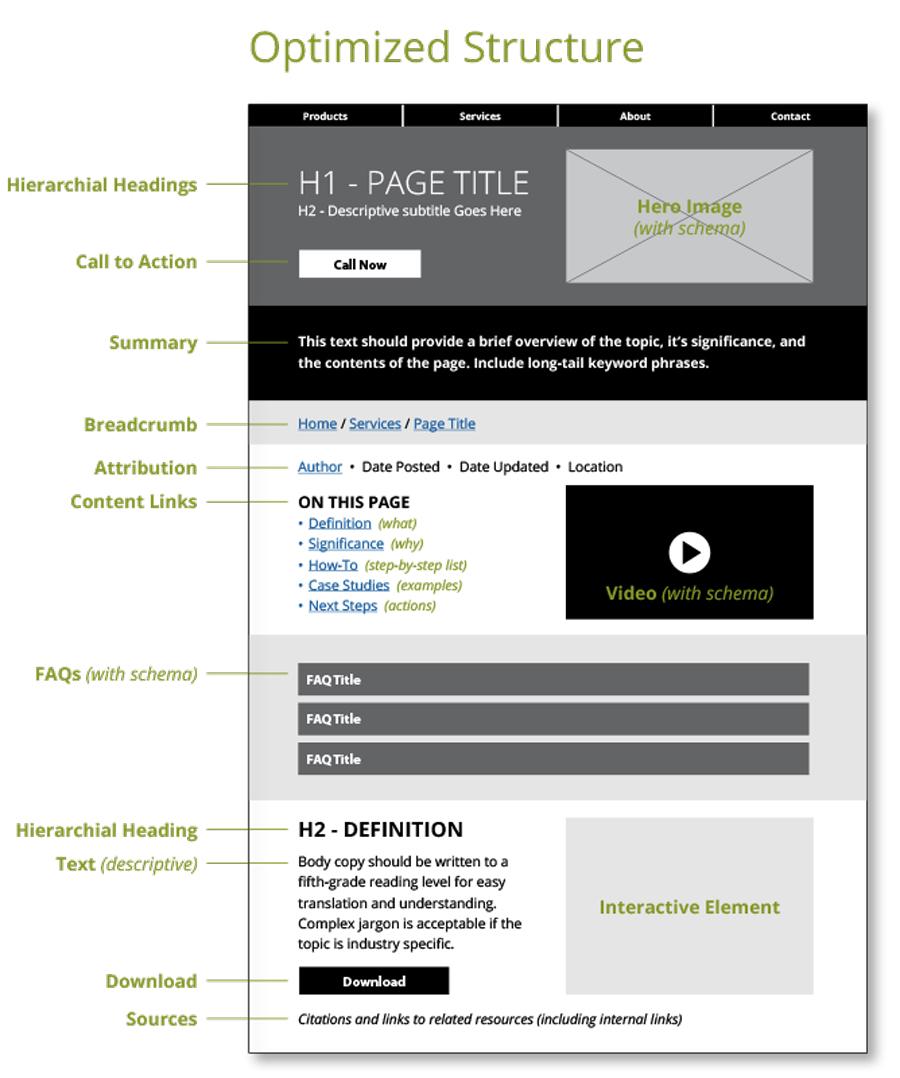
To help you put this into practice, here’s a sample content outline that’s strong for GEO:
- Title (often in question form)
- Summary (2-3 sentences)
- Table of Contents
- Definition (“What is…?”)
- Relevance (“Why it matters”)
- Step-by-Step (“How-do")
- Common Questions (FAQs)
- Case Studies
- Summary & Next Steps
- Media Elements (charts, infographics, videos)
Case Studies
Providing real-world (not hypothetical) illustrations of your key points is critical to localizing your page and establishing your authority on the topic. Readers will appreciate the narrative and honesty, while bots will include this information in their understanding of the page and your site overall. Don't be afraid to use your city or region's name (e.g., “Tacoma” or “South Sound”) and to provide details about your process.
Here's a quick case study template:
- Your client's challenge
What problem or challenge was your client facing when they came to you? (What wasn't working in their operation? What was it costing them?) - What they tried before
What had your client already tried to solve this problem? Why weren't those solutions working? - Why they chose you
Why did this client decide to work with Summit Packaging over other automation firms or solutions? - Your solution
What solution did you design and implement for them? What made your approach different or better? - The results
What specific, measurable results did your client achieve after implementation? (Include metrics like: production increase %, downtime reduction, cost savings, ROI, payback period, labor reduction, quality improvements, etc.) - Client feedback
What did the client say about working with you and the results? Do you have any direct quotes from them?
E-E-A-T Framework
E-E-A-T stands for Experience, Expertise, Authoritativeness, and Trustworthiness. It is a framework Google uses to evaluate content quality. While not a direct ranking factor, demonstrating strong E-E-A-T signals can improve search rankings by aligning content with Google's quality guidelines. The addition of the first "E" for "Experience" emphasizes the value of first-hand, real-world knowledge alongside traditional expertise.
Experience
- This refers to the creator's first-hand experience with the topic.
- Content that is based on personal experience is valued, such as a product review from someone who has used it.
Expertise
- This refers to the creator's knowledge and skill in a particular field.
- For complex topics like medical or legal advice, the content should be created by experts in that field.
Authoritativeness
- This refers to the creator and the website being recognized as a go-to source for the topic.
- This can be built through factors like receiving links from other reputable websites.
Trustworthiness
- This is the most important element and refers to the credibility of the content creator and website.
- It involves accuracy, reliability, and safety.
- Building trust can be achieved through clear contact information, positive reviews, and secure websites.
Why E-E-A-T is important
- Fights misinformation: E-E-A-T helps ensure that search results are accurate and reliable, especially on sensitive topics.
- Improves search rankings: Content that follows E-E-A-T guidelines is more likely to rank higher in search results.
- Aligns with Google's goals: E-E-A-T helps Google provide high-quality, helpful content that users can rely on.
Measuring GEO Success
Here are metrics you can use to gauge how well you’re doing GEO:
- Frequency: How often your content appears in AI answers or overviews
- Citations: Brand mentions (linked and unlinked)
- Content: Queries where your content is the source
- Engagement: dwell time, bounce rate, scroll depth
- Conversion: Metrics tied to AI traffic or referral sources
Final Thoughts
Generative Engine Optimization is rapidly becoming essential for brands and creators who want to stay visible in the era of AI-assisted discovery. The brands that are cited early, consistently, and with authority will build trust, drive traffic, and gain a competitive advantage.
If you adopt GEO best practices now (structured, authoritative, clear content, technical readiness, and consistent monitoring), you can ride the wave rather than be left behind.
Test Your GEO Knowledge
Was this article helpful?
Common Questions
Not entirely. GEO changes how visibility is measured — not just ranking, but also being cited in AI responses. Traditional SEO fundamentals still help. Many businesses will combine them for the best results.
You can monitor AI answer engines (ChatGPT, Gemini, Bing AI, Perplexity) to see whether your content appears, check tools that track brand mentions or AI visibility, and use analytics to see where traffic or referrals are coming from. Also, you can test specific queries to see which sources are pulled.
Yes. Schema markup helps, and research tools (long-tail keyword discovery, question tools) are critical. But it’s not only about tools — writing style, credibility, structure, and distribution matter a lot.
GEO stands for “generative engine optimization,” which means the process of updating your website to improve visibility in AI-driven search tools like ChatGPT, Perplexity, Gemini, Copilot, and Google AI Overviews. Traditional search engine optimization (SEO) often lays the foundation for GEO. When combined, they can create a powerful marketing strategy.
Related Stories
WCAG 2.2 Changes + Rules ExplainedWhat is Schema and How it Benefits Your Website5 Reasons Your AI Website SucksMarketing Funnels: Attract + Convert Local CustomersTrending Stories
Latest Trends in Graphic Design: Defining 2025WCAG 2.2 Changes + Rules ExplainedNever Perfect, Never Over: A Documentary That MattersRelated Services
Branding + LogosGraphic DesignLocal AdvertisingMarketing SolutionsCommercial PhotographySearch OptimizationVideo ProductionWebsite Design
